On the day of Narasingha Chaturdasi, the glories and divine pastimes of Lord Narasingha deva, were chanted in the Satsanga. According to Vedic understanding Narasingha Chaturdasi is the most auspicious day because on this very auspicious day Lord Krsna incarnated as Lord Narasingha deva to protect His dear most devotee Sripad Prahlad Maharaja. Srila Prabhupada has explained from Srimad Bhagavatam that Sripad Prahlada Maharaja is the best among exalted devotees.
After Prahlad Maharaja pacified Lord Narasingha deva with prayers, Lord Narasingha deva said, “My dear Prahlada, most gentle one, best of the family of the asuras, all good fortune unto you. I am very much pleased with you. It is My pastime to fulfill the desires of all living beings, and therefore you may ask from Me any benediction that you desire to be fulfilled.” Narada Muni explains that although Prahlada Maharaja was only a boy, when he heard the benedictions offered by Lord Narasingha he considered them impediments on the path of devotional service. Thus he smiled very mildly and spoke as follows: My dear Lord, O Supreme Personality of Godhead, because I was born in an atheistic family I am naturally attached to material enjoyment. Therefore, kindly do not tempt me with these illusions. I am very much afraid of material conditions, and I desire to be liberated from materialistic life. It is for this reason that I have taken shelter of Your lotus feet. O my worshipable Lord, because the seed of lusty desires, which is the root cause of material existence, is within the core of everyone’s heart, You have sent me to this material world to exhibit the symptoms of a pure devotee. Otherwise, O my Lord, O supreme instructor of the entire world, You are so kind to Your devotee that You could not induce him to do something unbeneficial for him.
Prahlad Maharaja continued, “On the other hand, one who desires some material benefit in exchange for devotional service cannot be Your pure devotee. Indeed, he is no better than a merchant who wants profit in exchange for service. A servant who desires material profits from his master is certainly not a qualified servant or pure devotee. Similarly, a master who bestows benedictions upon his servant because of a desire to maintain a prestigious position as master is also not a pure master. O my Lord, I am Your unmotivated servant, and You are my eternal master. There is no need of our being anything other than master and servant. You are naturally my master, and I am naturally Your servant. We have no other relationship.”
In the Satsanga, HH BhaktiMadhav Puri Swami did invocation prayers to Prahlad Maharaja and Narasingha deva. Then Maharaja engaged devotees in reciting the glories of Sripad Prahlad Maharaja and Sri Narasingha Deva. Details are provided below:
1) The summary of Srimad Bhagavatam chapter, (Canto 7, chapter 8 ) Lord Narasingha slays the King of the Demons — http://vedabase.net/sb/7/8/summary/en
3) For auspiciousness HH Bhakti Madhava Puri Maharaj chanted the 108 Holy Names of Lord Narasingha Deva.
Srila Prabhuapada has given the teachings of Srimad Bhagavatam that, “This materialistic life means full of anxiety always. And spiritual life means without this anxiety. Just the opposite. Brahma-bhutah prasannatma. And what is the symptom of being joyful? That is also stated: na socati na kanksati. There is no lamentation or loss, and there is no hankering for gain. Everyone in this material world is hankering after some gain…The material waves are such that whatever we possess, we shall lose it. We have got this nice body, one day we have to lose it. Everything! You possess and lose, possess and lose. Therefore the…, punah punas car…, the same thing repeatedly: gaining and losing, and lamenting and hankering, lamenting and hankering. This is the position of material life.”
Prahlad Maharaja Prayed to Lord Narasingha Deva, “O my Lord, best of the givers of benediction, if You at all want to bestow a desirable benediction upon me, then I pray from Your Lordship that within the core of my heart there be no material desires. O my Lord, because of lusty desires from the very beginning of one’s birth, the functions of one’s senses, mind, life, body, religion, patience, intelligence, shyness, opulence, strength, memory and truthfulness are vanquished. O my Lord, when a human being is able to give up all the material desires in his mind, he becomes eligible to possess wealth and opulence like Yours. O my Lord, full of six opulences, O Supreme Person! O Supreme Soul, killer of all miseries! O Supreme Person in the form of a wonderful lion and man, let me offer my respectful obeisances unto You.
Lord Narasingha Deva then benedicted Prahlada Maharaja with the following words, “My dear Prahlada, a devotee like you never desires any kind of material opulences, either in this life or in the next. Nonetheless, I order you to enjoy the opulences of the demons in this material world, acting as their king until the end of the duration of time occupied by Manu. It does not matter that you are in the material world. You should always, continuously, hear the instructions and messages given by Me and always be absorbed in thought of Me, for I am the Supersoul existing in the core of everyone’s heart. Therefore, give up fruitive activities and worship Me. My dear Prahlada, while you are in this material world you will exhaust all the reactions of pious activity by feeling happiness, and by acting piously you will neutralize impious activity. Because of the powerful time factor, you will give up your body, but the glories of your activities will be sung in the upper planetary systems, and being fully freed from all bondage, you will return home, back to Godhead. One who always remembers your activities and My activities also, and who chants the prayers you have offered, becomes free, in due course of time, from the reactions of material activities.”
In the Satsanga, there was also a brief discussion about the ontological position of Jaya and Vijaya, who are the two gate keepers of Vaikuntha and were cursed to appear in the material domain as asuras for three births.
saksad-dharitvena samasta-sastrair
uktas tatha bhavyata eva sadbhih
kintu prabhor yah priya eva tasya
vande guroh sri caranaravindam
In the revealed scriptures it is declared that the spiritual master should be worshiped like the Supreme Personality of Godhead and this injunction is obeyed by pure devotees of the Lord. The spiritual master is the most confidential servant of the Lord. Thus let us offer our respectful obeisances unto the lotus feet of our spiritual master .
Gentlemen, on behalf of the members of the Bombay branch of the Gaudiya Math, let me welcome you all because you have so kindly joined us tonight in our congregational offerings of homage to the lotus feet of the world teacher, acaryadeva, who is the founder of this Gaudiya Mission and is the President-acarya of Sri Sri Visva Vaisnava Raja Sabha-I mean my eternal divine master, Om Visnupada Paramaharnsa Parivrajakacarya, Sri Srimad Bhaktisiddhanta Saraswati Goswami Maharaja.
Sixty-two years ago, on this auspicious day, the acaryadeva made his appearance by the call of Thakura Bhaktivinoda at Sri Ksetra, Jagannatha Dhama at Puri.
Gentlemen, the offering of such an homage as has been arranged this evening to the acaryadeva is not a sectarian concern, for when we speak of the fundamental principle of gurudeva or acaryadeva,we speak of something that is of universal application. There does not arise any question of discrirninating my guru from yours or anyone else’s.
There is only one guru, who appears in an infinity of forms to teach you, me and all others.
In the Mundaka Upanisad (1.2.12) it is said:
tad-vijnartham sa gurum evabhigacchet samit-panih srotriyam brahma-nistham
“In order to learn the transcendental science, one must approach the bona fide spiritual master in disciplic succession, who is fixed in the Absolute Truth.”
Thus it has been enjoined herewith that in order to receive that transcendental knowledge, one must approach the guru. Therefore, if the Absolute Truth is one, about which we think there is no difference of opinion, the guru cannot be two. The acaryadeva to whom we have assembled tonight to offer our humble homage is not the guru of a sectarian institution or one out of many differing exponents of the truth. On the contrary, he is the jagad-guru, or the guru of all of us, the only difference is that some obey him wholeheartedly, while others do not obey him directly.
In the Bhagavatam (11.17.27) it is said:
acaryam mam vijaniyan
navamanyeta karhicit
na martya-buddhyasuyeta
sarva-deva mayoguruh
“One should understand the spiritual master to be as good as I am,” said the Blessed Lord. “Nobody should be jealous of the spiritual master or think of him as an ordinary man, because the spiritual master is the sum total of all demigods.” That is, the acarya has been identified with God Himself. He has nothing to do with the affairs of this mundane world. He appears before us to reveal the light of the Vedas and to bestow upon us the blessing of full-fledged freedom, after which we should hanker at every step of our life’s journey.
The transcendental knowledge of the Vedas was first uttered by God to Brahma, the creator of this particular universe. From Brahma the knowledge descended to Narada, from Narada to Vyasadeva, from Vyasadeva to Madhva, and in this process of disciplic succession the transcendental knowledge was transmitted by one disciple to another till it reached Lord Gauranga, Sri Krsna Caitanya, who posed as the disciple and successor of Sri Isvara Puri. The present acaryadeva is the tenth disciplic representative from Sri Rupa Goswami, the original representative of Lord Caitanya who preached this transcendental tradition in its fullness. The knowledge that we receive from our gurudeva is not different from that imparted by God Himself and the succession of the acaryas in the preceptorial line of Brahma. We adore this auspicious day as Sri Vyasa-puja-tithi because the acarya is the living representative of Vyasadeva, the divine compiler of the Vedas, Puranas, Bhagavad gita, Mahabharata and Srimad-Bhagavatam .
We cannot know anything of the transcendental region by our limited, perverted method of okservation and experiment. But all of us can lend our eager ears for the aural reception of the transcendental sound transmitted from that region to this, through the unadulterated medium of sri gurudeva or Sri Vyasadeva. Therefore, gentlemen, we should surrender ourselves today at the feet of the representative of Sn Vyasadeva for the elimination of all our differences bred by our unsubmissive attitude. It is accordingly said in the Bhagavad-gita (4.34):
tad viddhi pranipatena
pariprasnena sevaya
upadeksyanti te jnanam
jnaninas tattva darsinah
“Just approach the wise and bona fide spiritual master. Surrender unto him first and try to understand him by inquiries and service. Such a wise spiritual master will enlighten you with transcendental knowledge, for he has already known the Aksolute Truth.”
To receive transcendental knowledge, we must completely surrender ourselves to the real acarya in a spirit of ardent inquiry and service. Actual performance of service to the Absolute under the guidance of the acarya is the only vehicle by which we can assimilate transcendental knowledge. Today’s meeting for offering our humble services and homage to the feet of the acaryadeva will enable us to be favored with the capacity of assimilating the transcendental knowledge so kindly transmitted by him to all persons without distinction.
Gentlemen, although it is imperfectly that we have been enabled, by his grace, to understand the sublime messages of our acaryadeva, we must admit that we have realized definitely that the divine message from his holy lips is the congenial thing for suffering humanity. All of us should hear him patiently. If we listen to the transcendental sound without unnecessary opposition, he will surely have mercy upon us. The acarya’s message is to take us back to our original home, back to God. Let me repeat, therefore, that we should hear him patiently, follow him in the measure of our conviction and bow down at his lotus feet for releasing us from our present causeless unwillingness for serving the Absolute and all souls.
Sitting at the feet of the acaryadeva, let us try to understand from this transcendental source of knowledge what we are, what is this universe, what is God, and what is our relationship with Him. The message of Lord Caitanya is the message for the living entities and the message of the living world. Lord Caitanva did not bother himself for the upliftment of this dead world, which is suitably named Martyaloka, the world where everything is destined to die. He appeared before us four hundred and fifty years ago to tell us something of the transcendental universe, where everything is permanent and everything is for the service of the Absolute. But recently Lord Caitanya has keen misrepresented by some unscrupulous persons, and the highest philosophy of the Lord has been misinterpreted to be the cult of the lowest type of society. We are glad to announce tonight that our acaryadeva, with his usual kindness, saved us from this horrible type of degradation, and therefore we bow down at his lotus feet with all humility.
We are happy that we have been relieved of this horrible type of malady by the mercy of His Divine Grace. He is our eye-opener, our eternal father, our eternal preceptor and our eternal guide. Let us therefore bow down at his lotus feet on this auspicious day.
Gentlemen, although we are like ignorant children in the knowledge of Transcendence, still, my gurudeva has kindled a small fire within us to dissipate the invincible darkness of empirical knowledge. We are now so much on the safe side that no amount of philosophical argument by the empiric schools of thought can deviate us an inch from the position of our eternal dependence on the lotus feet of His Divine Grace.
Gentlemen, had he not appeared before us to deliver us from the thralldom of this gross, worldly delusion, surely we should have remained for lives and ages in the darkness of helpless captivity. Had he not appeared before us, we would not have been able to understand the eternal truth of the sublime teaching of Lord Caitanya.
Personally, I have no hope for any direct service of the coming crores of births in the sojourn of my life, but I am confident that some day or other I shall be delivered from this mire of delusion in which I am at present so deeply sunk. Therefore let me with all my earnestness pray at the lotus feet of my divine master to allow me to suffer the lot for which I am destined due to my past misdoings, but to let me have this power of recollection: that I am nothing but a tiny servant of the Almighty Absolute Godhead, realized through the unflinching mercy of my divine master. Let me therefore bow down at his lotus feet with all the humility at my command.
Abhay Charan Das [early name of A. C. Bhaktivedanta Prabhupada]
For Members, Sri Gaudiya Math
Bombay
-This lecture was originally published in The Harmonist in 1936, on the advent day of His Divine Grace Om Visnupada Srila Bhaktisiddhanta Sarasvati Thakura.
Lord Ramacandra appeared on this day. Today is called Sri Rama Naumi. On the ninth day of the moon Lord Ramacandra appeared. His father was the king of Ayodhya. Ramacandra is the eldest son. The life and activities of Lord Ramacandra is in a book which is called Ramayana. You have heard the name of Ramayana.
Here is a recording of Srila Prabhupada Hawaii 1969.
This is a verse from Brahma-samhita in which the incarnation of Lord Ramacandra is described. Ramadi. Not only Rama, but there are many other, innumerable incarnations. They are compared with the waves of a river. As the waves of the river or the waves of the ocean cannot be counted, similarly, how many incarnations are there of the Supreme Lord it is not possible to count. But out of them, the principal names are mentioned in the sastras. Therefore it is said ramadi. Ramadi means Rama and also other, many incarnations. And they are existing. Not that one incarnation appeared and it is finished. No. Not like that. Just like Lord Ramacandra appeared on this planet, say millions of years before. He appeared in the Treta-yuga. Treta-yuga means… We have passed only five thousand years of this age, Kali-yuga. Before that, there was Dvapara-yuga. Dvapara-yuga means 800,000 years. And before that, there was Treta-yuga, which continued for twelve hundred thousands of years. That means at least two million years before Lord Ramacandra appeared on this planet.
So now Lord Ramacandra appeared in Ayodhya. There is a place in Ayodhya, in northern India. There He appeared. As Kanna appeared in Mathura… That is also northern India. And Mathura is about ninety miles down southward from New Delhi. You have heard the name of New Delhi, the capital of India. So Ayodhya is also situated about five hundred miles northeast of New Delhi. So Lord Ramacandra appeared on this day. Today is called Sri Rama Naumi. On the ninth day of the moon Lord Ramacandra appeared. His father was the king of Ayodhya, and he had three wives. So out of… No. He had two wives. So out of two wives he got four sons. Ramacandra is the eldest son. The life and activities of Lord Ramacandra is… [break] …in a book which is called Ramayana. You have heard the name of Ramayana. Ramayana is also accepted as history. Vedic literatures are histories also. The Puranas, the Srimad-Bhagavatam, Mahabharata, and Ramayana, they are counted amongst the history. The history of Ramacandra is that His father wanted to retire. Dasaratha, Maharaja Dasaratha. And he decided to enthrone Lord Ramacandra and retire. So everything was settled, but just one day before, his youngest wife turned the whole thing into different way. Sometimes Maharaja Dasaratha was suffering from what is called whitlow, some trouble in the finger? And this queen served him very nicely, and he was pleased. And he said, My dear Sarmin ha, if you want some benediction from me, I can give you. And she replied that I shall ask you for the benediction when I require it. Not now. So just one day before Lord Ramacandra’s coronation, she approached her husband Maharaja Dasaratha and reminded him, My dear husband, you promised to give me some benediction, and I told you that I shall ask you when I require it. Maharaja Dasaratha said, Yes, I remember. You want some benediction just now? She said, Yes. And what is that? She said that Ramacandra cannot be seated on the throne. My son should be coronated, Bharata. He was surprised. It is a big demand. So he said, All right. That will be done. Your son. Because formerly, the kings… Not only formerly, even up to date, there are many ksatriya kings in India. They have more than one wife. And they are, naturally, there is rivalry between different wives. So the same thing. Human psychology is the same. Even two million years ago the same mentality was there, and she asked that My son should be the king, not Ramacandra. Ramacandra happened to be the son of Kausalya, the elder queen.
So Maharaja Dasaratha agreed and called for Ramacandra. My dear boy, your… She asked also that… She was very diplomatic. She wanted that Ramacandra go to forest for fourteen years. The idea was political, that The king may agree to install my son just now. Now, after a few days, this Ramacandra may come with His army, and there may be some difficulty to continue the kingdom. So she wanted that Ramacandra should go to the forest and He should not come back till the end of fourteen years from this day. So Maharaja Dasaratha agreed. Because he was ksatriya. Just see the promise. A ksatriya never goes back from the promise, never refuses any challenge. If a ksatriya is challenged by somebody, that I want to fight with you, oh, he cannot refuse. This is ksatriya spirit. He cannot say that I am now busy. Suppose somebody comes to you, that I want to fight with you. You may say, What nonsense fight? I have no time. We are in the temple. But a ksatriya cannot deny that. A ksatriya at once must accept. Oh, yes. Come on. And the weapon should be, if he has no sword or weapon, he should be supplied weapon and fight. This is ksatriya spirit. They were highly charitable and chivalrous and keeping promise and with a great tendency for ruling over. They shall rule over. Administrators. Their business is…
There are different prescription for different classes of men for their livelihood. The brahmanas, they can pull on their livelihood by six ways. Pa hana pa hana yajana yajana dana pratigraha. Six. And they must be qualified with twelve high qualities. We have many times discussed. Out of that qualification, truthfulness is the first item for a brahmana. A ksatriya may speak lies. That is allowed, because he has to be diplomat, politician. But a brahmana, oh, he’s not allowed to speak lie. This is the system, caste system or varnasrama system. Everyone was trained. Because these four classes of men are required in a society. For proper upkeep of society, one class of men must be very intelligent, highly qualified, with all good qualities. They must be trained in that way, ideal character so that people can see and follow them. Therefore brahmanas were taken to so much respect because they’re ideal character, learned, and godly, knows the science, spiritual science. Therefore they’re held in high estimation and topmost of the society. The next, the administrator, administrative class, ksatriyas. They are trained how to kill. The ksatriyas were allowed to hunt in the forest to learn the art of killing because that was necessity for the ksatriyas. Knatriya, if he… If the king, if he finds somebody is doing wrong, he can immediately chop off his head if he likes. The king was so powerful. And it is not that if there was some war, it is not that the president or the king shall sit down comfortably at home and ordinary soldiers will go and lay down their life. No. Formerly, the king or the head of the state, he should first of all go there in the fight. You see in the picture, the chief men of the fighting in the Kuruknetra, both sides, they were arrayed, this side, that side, with their chariot.
Not that the head man, the chief man, or the commander is taking shelter back side, protecting himself, and poor soldiers are (chuckles) thrown into the fighting. No. These were ksatriya spirit. And it is necessary that a class of men should be trained up in that way, ksatriya, fighting men. In India, because this training was there since a very long time, so there is no difficulty in recruiting soldiers there. There is a class of men, they are very much forward in fighting still. They are called… Just like the Gurkhas, the Nepalese. You have heard the name of Nepal. Still a small state, independent state. They are not within India. Between China and India. The whole Nepal population, they are ksatriyas. Oh, they are very good fighters. Similarly, the Sikhs, the Jatas. There are classes. So they’re always forward for fighting. And you’ll be surprised that the British Empire was voluntarily liquidated because they lost India. The Britishers, they understood that because we are now losing India, there is no more possibility to keep our eastern empire. Therefore they liquidated. Why? Actually, the whole British Empire were being administered or managed by Indian soldiers, these Sikhs and Gurkhas. They extended their empire. After taking their position with India, they extended British Empire in the Middle East and Far East simply by these Sikhs and Gurkha soldiers. They got supremacy on the Burma and everywhere.
So there is necessity of a class of fighting men. You are finding in your country difficulty in recruiting because the recruiting process is wrong. You are recruiting from persons… You are training persons just like sudras, and you want them to fight. How they can fight? It is not possible. So as it is stated in the Bhagavad-gita, that catur-varnyam maya san am guna karma vibhagasa … [Bg. 4.13]. Lord Kanna said that The four classes or orders of the society, brahmana, ksatriya, vaisya, sudra, is planned by Me according to work and quality. So this ksatriya quality men is also required, the brahmana quality of men is also required, the mercantile community, they are also required, and the laborer class, they are also required. Of course, laborer class, they do not require any training. Laborer class means one who cannot do anything, neither become brahmana, nor become ksatriya, nor become vaisya. That means the last balance of the population, they are called laborer class, sudra. Sudra means one who has no training. Sudra has no samskara. Samskara means training. Everyone is accepted as sudra by birth. Janmana jayate sudra. Janmana means by birth. By birth, everyone is born a sudra, a fourth-class man. It is to be accepted, and actually so. Just like a child, innocent child, what does he know? He has to be trained. Either you train him as a brahmana or train him as a ksatriya or train him as a vaisya. Or otherwise, he is sudra already, born sudra. Sudra has no training. Everyone, the basic principle, basic foreground, everyone, it is accepted sudra. Now, if you train him as a brahmana, then he becomes a brahmana. If you train him as a ksatriya, then he becomes a ksatriya. If you train him as a vaisya… So I think this is, this system is very scientific so that if you want help of a really intelligent man or God realized man, it is ready, the brahmana class. Just like if you require the help of a lawyer, we have got so many lawyers. If you require the help of medical man… Because there are trained men. Similarly, the society requires to train a certain class of men to become brahmanas.
Just like we are training the Kanna conscious. The Kanna consciousness is meant for the brahmanas. They are not meant for fighting because they are not being trained for fighting. They have been trained for becoming brahmanas. Who is brahmana? Brahma janati iti brahmana. The four divisions are described like this. Janmana jayate sudra , everyone is born sudra. That is accepted. Samskarad bhaved dvija . Now if you train him, never mind in which family he’s born, you have to train him. Just like boys are sent to school for being trained. So everyone is accepted as sudra, but you now train him. He goes to the guru-gaha. Guru-gaha means teacher’s house. Formerly, for being trained, there was no such big scale school and colleges. Every village… Still, fifty years before in India, in every village there was a small school conducted by the brahmana, and the village children would be trained up there. So he was sent for training. And there was no school fee. The boys will go there, and on behalf of the teacher or spiritual master, they will go, brahmacari, door to door, and beg and bring forth alms, rice, dahl, grains, and everything. That was the system. There was no school fee. There was no problem how to send a boy to the school. Samskara. Now he’s trained up. The teacher sees the psychology of the boy, in which way he should be trained. Either he should be trained as a vaisya or he should be trained as a ksatriya. So everyone was trained like that, but generally, the son of a ksatriya… Just like Maharaja Ramacandra or Arjuna, from the very beginning they were trained as ksatriya. Naturally, if somebody is the son of a medical man his father trains him to become a medical man in future. That is the natural tendency. If the boy is different altogether that is another question, but naturally, that is the tendency. So a ksatriya’s son was trained as ksatriya. A brahmana’s son was trained as a brahmana and a vaisya’s son was trained as a vaisya, and sudra had no training. So gradually this became a caste system. Brahmana’s son became brahmana. Because formerly, the training was there. But when it is vitiated, although a person born in the family of a brahmana, he is doing the work of a sudra. So according to Vedic scripture, one is classified according to his work and quality, not by birth. That is the classification of sastra. Just like in the Bhagavad-gita the Lord says catur-varnyam maya san am guna-karma-vibhagasa [Bg. 4.13]. Guna means quality and karma means work. One must be qualified for the work and he must actually work. Then he is counted classified into that, I mean to say, category.
Just like if you are simply trained or educated as a lawyer, and if you are not practicing in the court, nobody comes to you to consult as a lawyer. Nobody cares for you. You must be practicing also. Similarly, to become a brahmana means first of all, he must know what is Brahman and he must be actually situated in the activities of Brahman. So devotional service are activities of Brahman. Activities in Kanna consciousness means activities in Brahman. Brahme carati iti brahma brahmacari. Carati means acts. Actually, he acts in life, applies the principles of brahmana in his life, he is called brahmacari. So these were the trainings. So just see how the training was, that a ksatriya cannot refuse his promise. So Maharaja Dasaratha, he fulfilled the promise of his youngest wife and asked his son, eldest son Ramacandra, My dear boy, You’ll have to go to forest for fourteen years. That is the desire of Your youngest mother. And I promised that I shall fulfill her promise, uh, request. So please accept. Ramacandra said, Yes father, I am ready. Just see. This is the quality. Out of the six opulences of God, this is one quality.
How one becomes God? God is not manufactured by vote. There are definition who is God. God must be the proprietor of all the riches. Aisvaryasya samagrasya. Samagra means all. Nobody can compete with Him. Here, in this world, material world, I am rich man, and there is another rich man who can compete with me. There is another rich man who can compete with him. But nobody can compete with God in richness. That is one qualification of God. Nobody can say that I am richer than God. You can say I am richer than Ford or Rockefeller or this or that. You can say. But nobody can say that I am richer than God. Therefore in the Bhagavad-gita it is said matta parataram nanyat asti ki cid dhana jaya. Matta parataram nanyat ki cid asti dhana jaya [Bg. 7.7]. Dhana jaya is a name of Arjuna, and Kanna said that, My dear Arjuna, there is nobody greater than Me. So if anyone claims that he is God, he must prove by practical example that nobody is richer than him. That is the first. But unfortunately, we are accepting so many Gods. A rascal in the street, he also claims that I am God.
So similarly, the other qualification, nobody can be stronger than God, nobody can be wiser than God, nobody can be more beautiful than God, and nobody can be more renouncer than God. So here Ramacandra, Lord Ramacandra exhibited the quality how He renounced the whole kingdom simply on the order of His father, His obedience to father. He could have argued with His father, My dear father, you, simply for keeping your promise and actuated by the dictation of a woman, you are doing this. Let us stop it. Everyone is expecting that tomorrow My coronation will be there, and they love Me so much. Because He… Just like Kanna was so much loved, similarly, Lord Ramacandra was the life of the people. They were very much expecting that Ramacandra was going to be enthroned tomorrow. So how they were celebrating, how they were decorating the whole city. Everything. He never argued. He accepted immediately: Yes, father. I am ready.
So then one of the brothers, Laknmana, He also requested Ramacandra, My dear brother, You also take Me. I am Your constant companion. I must go with You. So He said, That’s Your wish. Voluntarily, if You want to come, You can come with Me. Then Sita, His wife, young wife, She also said, I’ll go with You. Ramacandra requested His wife, Oh, you cannot go with Me. It is very difficult. You are a king’s daughter, and you are brought up in so nice way, and you are so beautiful. You cannot go. You cannot take the trouble of living in the forest. So she said, Oh, I am Your wife. Married wife. So I must go even if You go to hell. This is ideal wife. She could have refused: Oh, Your father has ordered to go to forest. You can go. I shall go to my father’s house or I shall remain here. No. This is ideal wife. She must be prepared to accept any circumstances of the husband. Not that when the husband is rich the wife is very faithful, and when he has come down to be poor or he’s going to forest the wife gives up his company. No. Wife means better half. She must abide. Just like, it is said, just like a shadow follows the reality, similarly, the wife is the shadow of the husband. Wherever the husband goes, she must go. Whatever the husband wants, she must carry out. Of course, in this country this interpretation is taken differently, that wife is made a slave. But actually, it is not so. When Sita was kidnapped in the jungle, Ramacandra expected that, that she was beautiful, she was young, and We shall be in open jungle. It may be some demons may come, and actually it so happened. So for Sita, Lord Ramacandra massacred the whole family of Ravana. Only for Sita. So as the husband, so the wife. The wife was so faithful that she could not remain alone. She must accompany the husband even in the forest. And the husband was so faithful that, Oh, my wife has been kidnapped. So He massacred the whole family of Ravana.
So these are ideal history how… Ramacandra, Lord Ramacandra appeared on this world to educate or to place ideal example of a king. How the king should be. Therefore when there is good government… The example is given, Rama-rajya. Rama- rajya. It is the kingdom of Lord Rama. Because everyone was happy, everyone. There are so many instances in the life of Ramacandra. One brahmana… Not brahmana exactly. Somebody came to Ramacandra. Because at that time there was no court like this, that you have to go to a court and apply with stamp fee. Then your judgment will be delivered after six years. It is not like that. Anyone who has got some complaint, he should… The king used to sit in the open audience, and the citizens were allowed to approach the king and place their complaints. Because there was no complaint practically. Everyone was happy. Very minor complaint. So somebody came to Ramacandra, and he charged Ramacandra, My dear king, my son has died. How is that, in the presence of his father, son can die? There must be something wrong in Your government. Just see. The charge is Why my son has died before my death? This is unnatural. So there was nothing unnatural. The king was responsible even for severe cold, severe heat. That we get from history of Srimad-Bhagavatam. That is stated.
So the kings were so much responsible. They were always thinking of the happiness of the citizens, and the citizens were also so nice. One citizen approached Lord Ramacandra and His next assistant, His brother, Laknmana, informed Him that He is a brahmana. You were absent on Your tour for, I think for a fortnight or a month, and this brahmana has not eaten even a drop of water during Your absence. Why? Because he comes here to see You, darsana. Just like we come here in the temple to see the Deity. So Lord Ramacandra was present personally. So he used to come. After seeing Ramacandra, offering his obeisances, then he would go home and take something, his breakfast. That was his vow. And because he could not see for a fortnight or a month Lord Ramacandra because He was out on political tour, he did not eat even. Just see. The citizens were similar to the king. So at that time, there was a statue of Ramacandra which was being worshiped in the family from Maharaja Iknvaku. Maharaja Iknvaku, the son of Manu, happens to be the forefather of the family in which Ramacandra appeared. So he was devotee of Lord Rama, and he was worshiping the statue of Lord Rama. So that statue was being worshiped by the family one after another. But when Ramacandra was actually present He kept that statue in the closet of the room, and when this brahmana approached and Ramacandra was informed by Laknmana that he is so steady and strong in his vow, so Ramacandra ordered that he may be delivered that statue so that in My absence he can offer respect to the statue and do with this. That form, I mean to say, statue, or arca of Ramacandra is still existing in South India. It is being worshiped from that time.
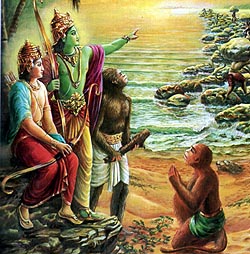
So these were the dealings of Ramacandra. Then He, His younger brother Laknmana and His wife went to the forest, and His wife was kidnapped by the diplomacy of the demon Ravana, and there was fight between Rama and Ravana. Ravana was very, materialistically, he was very strong. But the thing is for fighting with Ravana, Ramacandra did not come back to His kingdom and take His army. No. He did not come back because He was ordered to live in the forest. So He organized army with the jungle animals, the monkeys. The monkeys. He fought with Ravana, an organized materialist, with the monkeys. You have seen the picture. And He constructed a bridge between India’s last point to the other side. Ceylon is considered to be the kingdom of Ravana. So there was a bridge, and the stones were floating.
So there are so many historical incidences in the life of Ramacandra, and we should remember, because if we remember why we are observing today fasting for Ramacandra… There were many kings like Ramacandra. Because the kings were trained in that way. Maharaja Yudhin hira was also as good as Ramacandra, and Maharaja Pariknit was as good. There were many such kings. But we are not concerned because He was a king. He is the King of all kings, paramesvara. Because He is God, therefore we are observing today. Ramadi-murtinu kala-niyamena tin han [Bs. 5.39]. So He is not original form of God. The original form of God is Kanna, and Kanna expands Himself in various other forms. Advaitam acyutam anadim ananta-rupam [Bs. 5.33]. Ananta-rupam means millions and millions. The Manu is also incarnation of Kanna. So in one day of Brahma there are fourteen Manus. So Brahma lives for one hundred years. Just see how many incarnation of Manus are there even for one Brahma, and there are innumerable Brahmas also. So, as stated in the Srimad-Bhagavatam that nobody can count how many incarnations are there, but some of the chief incarnations are mentioned, and Lord Ramacandra is one of them. So Lord Ramacandra, He killed Ravana and He installed his brother. His brother was devotee, Vibhinana. So He did not go to conquer Ceylon, because He was emperor. He went to punish that culprit Ravana, and He installed his younger brother Vibhinana in that… And He came back with Sita, and again He was installed after fourteen years, and His brother was so faithful that so long His eldest brother was away, Ramacandra requested Him that Your mother wants that You should be king, and I also wish that in My absence You should be king. Bharata, He was so faithful brother, He replied, No. You are king. So long You are living, nobody can be king. So I cannot be king. Then He requested, At least You administer. Because after the departure of Lord Ramacandra, Maharaja Dasaratha died out of the shock because Ramacandra was very pet son, eldest son. He was going to be king, and by his order He was sent to the forest. The father could not tolerate the shock. He died. So Ramacandra’s life, God’s activities, pastimes, if we hear, that means we are associating with Ramacandra.
There is no difference between His form, His name, His pastimes, and Himself. He’s absolute. Therefore either you chant the holy name of Rama or you see the statue of Rama or you talk of His pastimes,transcendental pastimes, everything, that means you are associating with the Supreme Personality of Godhead. So we take advantage of these days when the incarnation of God appears or disappears, and we try to associate with Him. By His association we become purified. Our process is purification. Kanna consciousness means simply we are purifying our consciousness. From the birth, as I have explained, everyone is sudra. Sudra means one who laments. That is called sudra. For a slight loss or slight inconvenience, one who laments, he is called sudra. And brahmana means one who tolerates. A sudra has no toleration. So kalau sudra sambhava. Kalau means… This age is called Kali. So it is the statement of the sastras that in this age the whole population is sudra. And formerly also, by his birth, everyone was considered sudra, but there was training, samskara. At the present moment, there is no samskara, there is no training. The training is only for earning livelihood. No other training. How one can earn money and enjoy senses-that is the training at the present moment. But actually, to make successful the human life or the mission of human life, the Vedic culture is very nice. And by spreading Kanna consciousness, by adopting the process of Kanna consciousness, you can revive that cultural life, sublime life. If not wholesale, if there are a few people trained up in this line, and they become ideal examples to the society, immense benefit can be derived from their examples of life. What is time? [break]
(kirtana)
(end)
(A.C. Bhaktivedanta Swami Prabhupada 27th March 1969.
The Appearance day of Lord Rama – Ramanavami, Hawaii, USA.)

 made his appearance by the call of Thakura Bhaktivinoda at Sri Ksetra,